FlowGUT

Now validating

Dynamic intestinal permeability in the familiar Transwell workflow

Designed to help you test complex modalities under controlled dynamic conditions without moving away from standard Caco-2 workflows.

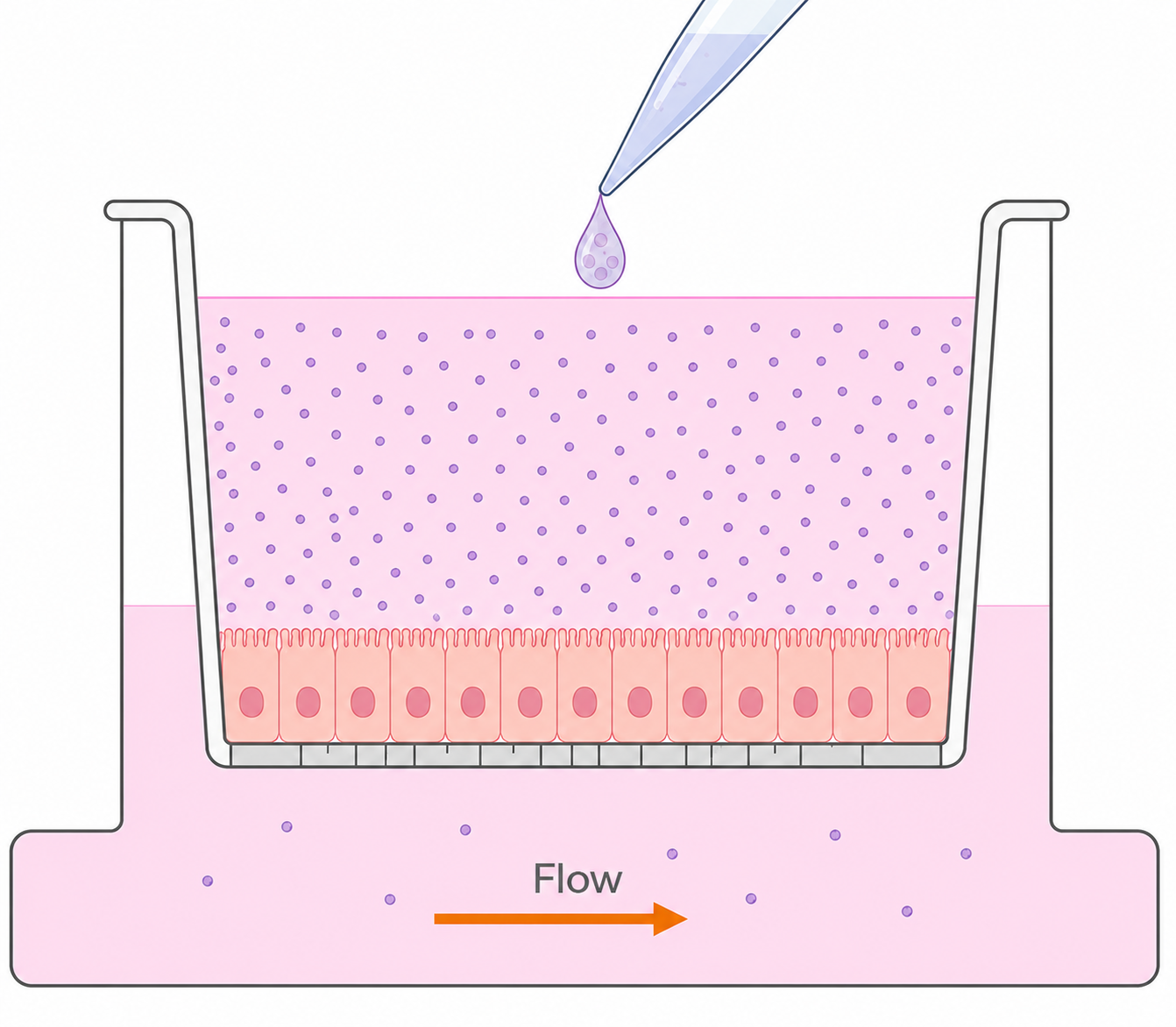
FlowGUT Transwell assay with controlled receiver-compartment flow
The assay

What changes in the assay?

Controlled flow in the receiver compartment

FlowGUT introduces controlled fluid movement below the Caco-2 barrier while keeping the familiar Transwell format, inserts and read-out workflow.

Instead of replacing the assay setup with a specialised microfluidic system, FlowGUT brings dynamic conditions into the plate format you already use.

Where it helps

Where FlowGUT can add value

Designed for permeability assays that are difficult to run reliably in static conditions

  • Low solubility / Poor solubility
  • Low permeability

Low solubility / Poor solubility

Poorly soluble compounds can make recovery and sink conditions limiting in standard static assays. FlowGUT is being evaluated to support a more homogeneous receiver environment under these challenging conditions.

Biorelevant intestinal media

Biorelevant intestinal media can improve solubilisation and better reflect intestinal conditions, but static Caco-2 models can struggle to maintain barrier stability under these conditions. FlowGUT is being evaluated to support these assays under controlled dynamic conditions.

Low permeability

When only a small fraction of the compound crosses the barrier, basolateral concentrations can be difficult to quantify reliably. Controlled receiver conditions can help support more robust permeability measurements for these challenging compounds.

Beyond-Rule-of-5 compounds

FlowGUT is being developed for challenging low-permeability oral compounds, including beyond-Rule-of-5 modalities, for which conventional Caco-2 assays increasingly run into technical limitations.

This reduces confidence in compound selection before costly downstream development.

What it supports

What FlowGUT is designed to support

A more physiologically relevant permeability environment

More homogeneous receiver conditions

Controlled flow is designed to reduce concentration gradients and create a more uniform receiver compartment.

Stable barrier conditions

FlowGUT is being evaluated for maintaining Caco-2 barrier stability under challenging and biorelevant assay conditions.

Improved assay robustness

Current validation focuses on whether dynamic conditions can improve recovery, reduce variability and increase confidence in permeability measurements.

Faster model preparation

In our current work, dynamic culture has shown faster Caco-2 differentiation compared with conventional static culture

Workflow fit

Fits into your existing workflow

Dynamic conditions without adding fluidic complexity

FlowGUT is designed to fit into existing ADME workflows rather than replace them.

  • Standard Transwell inserts
  • Familiar well-plate format
  • Standard incubator use
  • Familiar dosing and sampling
  • Compatible with standard analytical read-outs
  • No external pumps or tubing

The 24-well MACplate provides 24 independent samples in a standard plate footprint, with higher-throughput formats in development.

Flow is generated directly inside the plate

The MACplate contains magnetic hair-like structures that create controlled fluid movement in the receiver compartment. This allows the system to generate dynamic conditions without tubing, external pumps or a separate microfluidic circuit.

24-well MACplateIndependent samples in a standard plate footprint
Receiver-compartment flowControlled fluid movement beneath the Transwell insert
Validation

Current validation

Currently validating the parameters that matter in ADME

FlowGUT is being validated with CRO and industry partners across key permeability assay parameters.

Current work includes:

  • permeability of low-permeability compounds
  • compound recovery
  • receiver-compartment homogeneity
  • barrier stability under biorelevant conditions
  • assay variability and reproducibility
  • Caco-2 differentiation time

Several of these performance benefits are still under validation and are not yet final product claims.

Have an assay that is difficult to run reliably in static Caco-2?

We are currently working with CRO, pharma and biotech teams to validate FlowGUT on real permeability challenges.